WEEKLY MENU 10.12.25
It’s Columbus Day during the Weekly Menu 10.12.25, and we’re avoiding any controversy by talking about boats.

Columbus has become a fairly polarizing figure of late, but the banks and post offices are still closed on his day during the Weekly Menu 10.12.25. Instead of dwelling on what an absolute bad-guy he was, I figured I’d look into his boats instead. You remember from grade school: the Nina, the Pinta, and the Santa Maria!
The largest was a carrack, the Santa María, owned and captained by Juan de la Cosa, and under Columbus’s direct command.[103] The other two were smaller caravels, the Pinta and the Niña,[104] piloted by the Pinzón brothers.
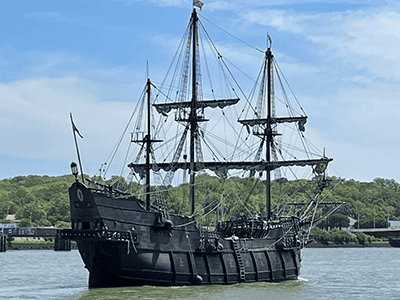
Replica of a CARRACK
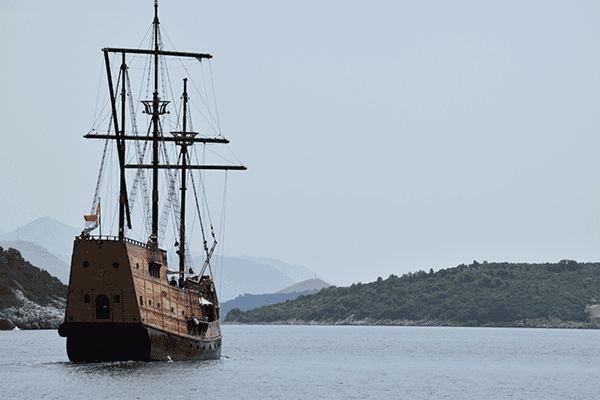
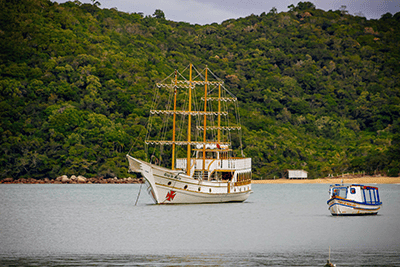
Replica of a CARAVEL (actually a tourist pirate boat, but we’ll take what we can get, non-copyrighted picture-wise.)
For 35 days, Columbus and his crew of 86 Spanish sailors sailed westward searching for a passage to China and India. With the men close to mutiny against their “foreign” captain, Columbus was about to turn back when the cry went out at 2 a.m. on October 12 that land had been sighted.
The main advantage of the Spanish caravel, namely its compact size, was also its greatest disadvantage. Life aboard a short ship like the Niña or Pinta would have been absurdly crowded and uncomfortable.
Unlike the Santa Maria, which at least had tiny cabins where sailors could sleep between eight-hour shifts, the Niña and Pinta had a single small deck at the rear of the ship with only one cramped cabin reserved for the captain.
More importantly than where they slept, where did they poop?
Pirates pooped at the “head” of the ship, which was the front (bow) and is the origin of the modern term for a ship’s bathroom. They would squat over grates with holes in the bowsprit deck to relieve themselves into the sea below. This area was often the cleanest on the ship due to waves washing over it and wasn’t at all related to the “poop deck,” which was at the stern.
Sadly, the poop deck had nothing (at all) to do with defecating. It means the highest deck on the stern of the boat in Latin. The sailors likely didn’t use the grated area to urinate. They’d let loose over the side of the boat, being cognizant of the wind direction, presumably.
What did they eat?
Sailors from the age of exploration did not get enough to eat. Most of their food came from a dry biscuit called hardtack. This was supplemented with salt pork, fish, beans, rice, and oil. The meats had to be dried, salted, smoked, or pickled to keep them from spoiling. The food would still sometimes go bad, or rats and mice would break in and eat or contaminate the supplies.
Because their voyages were powered by the wind, travel times were unreliable. Food and water had to be rationed to ensure there was enough to last. Despite their best efforts, food and water often ran out, leading to disease and misery for millions over the centuries.
So they likely weren’t using the grates too much. Hard to believe this is where the Weekly Menu 10.12.25 devolved to, but here we are. What can I say? It’s the boy-mom in me.
Speaking about the Weekly Menu 10.12.25…
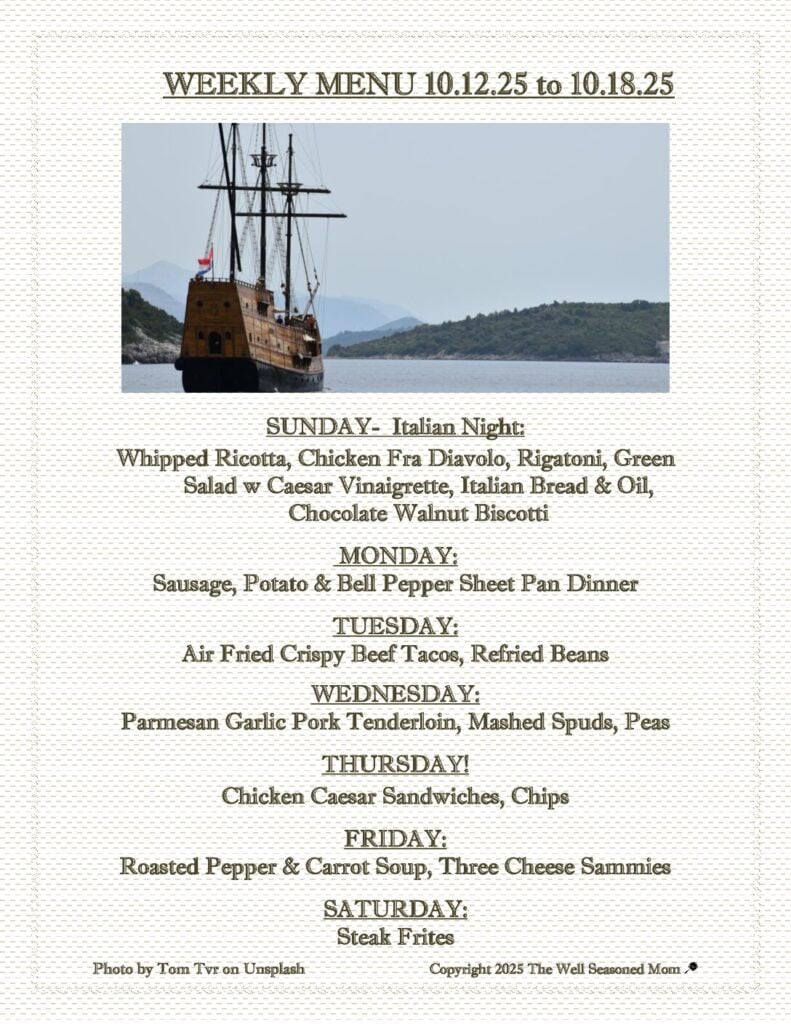
How are we “celebrating” Christopher Columbus during the Weekly Menu 10.12.25? Italian night, baby! (How else?) We’re starting with whipped ricotta, baby peppers, and crostini (little toasts). Then “D’s” favorite dinner: Chicken Fra Diavolo is in the house! Lightened up Caesar dressing (it’s a vinaigrette instead of a creamy version) and rigatoni round out dinner, along with some Italian bread in dipping oil.
With a meal this heavy, I like to serve a grab-and-go dessert, since we might need a few minutes to let everything settle. Biscotti are the perfect little bites, as long as I don’t make them ginormous, which I will avoid – pinky swear.
Sausage Sheet Pan Dinner makes an appearance this week, too. I’ll likely serve a mixture of regular Italian sausage and turkey sausage, although none of us can really tell the difference. I like the fat from the regular sausage to cook and crisp up the spuds. Good for us? Likely not. Delish? Absolutely.
WEEKLY MENU 10.12.25
RECIPE LINKS
WHIPPED RICOTTA
CHICKEN FRA DIAVOLO
CAESAR VINAIGRETTE
CHOCOLATE WALNUT BISCOTTI
SAUSAGE POTATO SHEET PAN DINNER
AIR FRIED CRISPY BEEF TACOS
PARMESAN GARLIC PORK TENDERLOIN
WEEKNIGHT MASHED SPUDS
CHICKEN CAESAR SANDWICHES
ROASTED PEPPER CARROT SOUP
I AM SUSPICIOUS OF A HOLIDAY DEVOTED TO A MAN’S INABILITY TO ASK FOR DIRECTIONS.
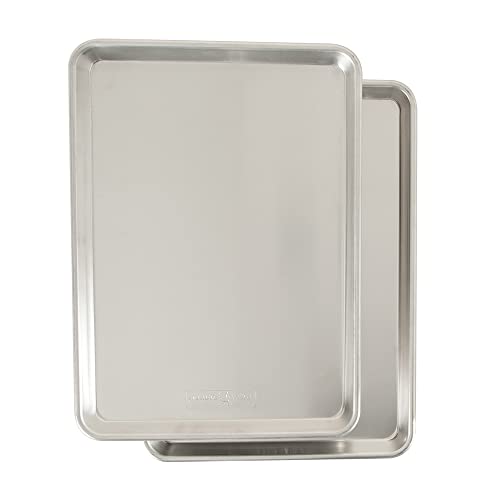
WEEKLY MENU 10.12.25 EQUIPMENT AND MISCELLANEOUS